Night Watch – Day 6 Bora Bora to Niue Passage

Here’s a bit of thick description regarding one aspect of life on board during a crossing.

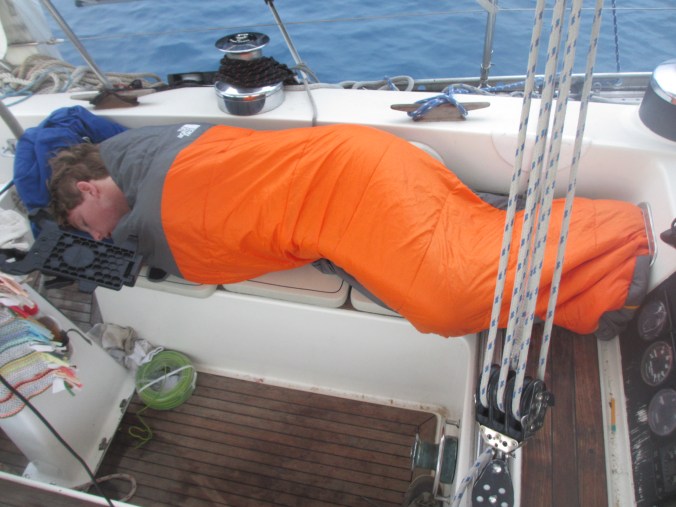
My internal body alarm sounded early this morning; a check of the ship’s clock indicated it was 2:40am – a good time to start getting ready to relieve Kim from her watch at 3:00. I awoke with an unusual feeling – I felt rested! I lay in my berth a minute to savor the feeling of 4 hours of solid sleep. I had helped Anson reef the jib a couple times earlier in the night, but had slept soundly since Kim’s watch began; in part, no doubt, due to the excellent chicken soup followed by applesauce cake, warm from the oven, we enjoyed for dinner. Then out of bed and up topsides to say hello to Kim. In the cockpit Kim was staring intently at the instruments, with one hand on the wheel to help Windy (our windvane) from letting Anthea round up in the increasing gusts. “Don’t come up here without a life jacket. There’s a squall coming!” Down I went to get the thing on and then back up. I could see the dark cloud to windward. Kim was watching the wind speed intently and wishing the rain would arrive as she knew the maximum wind coincides with the rain; was our reefed jib too much sail for the squall?, was the question. I went back down to start my coffee, got the water heating and added the instant coffee and sugar to my cup. I prefer the brown sugar as it has nice flavor and the rich fragrance reminds me of our dear friend Didi and her adobe house in the Himalaya foothills – a place of warmth and love for our family since the 90s. Anthea was quite lively, with plenty of pitching and tossing, so always had to be braced against something. Suddenly a wave of water came aboard and crashed against the dodger over the companion way entrance; most of the water sluiced back on the decks, but some came aft into the cockpit and spilled into the ports of the boys’ cabin. A loud yell from Devon indicated where at least some of it ended up. Off goes the stove and I make my way to their cabin to assess; water all over the cabin floor and on the seat cushions and less on the berths. Back to the galley, where Anson is now silently standing with water dripping off his torso and legs. He politely moves aside while I search for a dry cloth – a rare commodity at this stage in the passage. Going back to wipe things up, he asks me to be sure to get the top of his berth, “where it always drips.” After the clean up, I get back to my coffee making. Meanwhile, topsides, Kim is negotiating the squall. Top wind speed before the rain came was 30 knot gusts, which the jib could handle. So all fine, thanks to her excellent helm work. Anthea remains pretty lively in the steep wind waves. Once in the cockpit with my coffee I get the report from Kim about her watch, reconnect with the rhythms of our ship (wind speed, sail configuration, sea state, course, everything else that might need consideration), and sip my coffee. Kim then goes below. After helping the boys get back into their somewhat dry berths, she pops up the companion way entrance and, saying “here’s your cake!” and passes me a generous serving. Fresh baked cake, black coffee with brown sugar, a beautiful starry night and four hours of downwind sailing ahead, ending with dawn – this is the life!!

-Mark
Latitude 18 degrees 38.6 minutes south; longitude 162 degrees 58.4 minutes west

Life on a Passage

(Devon)
A passage is both a lot of work and a lot of rest. For Kim and Mark, a day usually consists of waking up or getting off watch and sleeping for an hour, eating breakfast, checking our route, washing dishes, telling me to dry, getting the weather off the SSB, updating the log. Then Kim goes on watch, 11-3, and Mark goes to bed. Lunch is eaten topsides (where they then congratulate me on making lunch in 6 to 8 foot seas on the beam and 20-25 knot winds), Kim finishes her watch, and Mark goes on watch. They eat dinner, congratulate me again, wash dishes, have me dry, update the log, and go to bed.
Anson wakes up and does his watch, 7-11 A.M., reads, eats lunch, reads or watches movies, does lunch dishes, asks me to dry, reads, eats dinner, and does the 7-11 P.M. watch.
I on the other hand do not have watches. I wake up, eat breakfast, do the dishes, read, make lunch, get congratulated, dry the dishes, read or make a treat, make dinner, get congratulated, dry the dishes, read and go to bed.
My job sounds very relaxed, but imagine doing it on a 41-foot boat tossing and turning on big swells that are twice the height of our deck, the wind howling in our rigging and hammering the ocean, drenching us, and tossing us across the cockpit. (By us, I mean Kim, Mark, and Anson; I rarely come up unless I am filling up a water bottle or fetching a hat.) It also makes cooking in the galley hard when you’re sliding over the floor and trying to dodge the sprays of boiling water while stirring the noodles. Making a Baked Good on Board.
On the second day out, I went through my virtual library and found that I didn’t have any good books! Without much else to do I turned to baking. I had been thinking about making cinnamon rolls for several days, so I started the several hour process right then.
I opened cupboards quickly and slammed them shut after timing the waves. Trying to keep one hand on the bowl, I mixed together the wet ingredients then added the dry. I nestled the bowl in a tight corner to rise. As the dough expanded, I made the sauce, bracing myself for each swell. We have only one counter space in our galley and it is over the fridge. I cleaned it, rolled out the dough and spooned on the sauce. I was unprepared for the mess it made! With each swell and with the heeling of our boat the sauce spread out onto the counter. When I chopped the dough into individual pieces and started to cook them, the fridge top was covered in the sticky sauce. The cleanup was hard, but I finished it before the golden treats came out of the oven. They lasted three days and everyone had a piece at tea, and before each watch. It took a lot of perseverance, but in the end it was worth every minute. Devon

PS from Kim Watching Devon bake the cinnamon rolls I realized he had coined a new event: Extreme Baking. To keep his balance, he hopped and slid; to keep items on the counter, he lunged and grabbed. He braced himself in corners and swayed with the waves. The gimballed stove rocked violently with the swells, and he timed his stirring for the seconds of flat. If I could have kept my balance I would have filmed him, but I needed both my hands to stabilize myself in the steep waves off our beam. We could probably make a million by starting a new reality TV show; each episode could feature baking under extreme conditions, with judges evaluating the physical skill and the delicacy!
Of course, after the Extreme Baking comes the Extreme Cleaning. While Devon took care of the counter and put all the ingredients away, I managed to clean all the bowls, pots and spoons with only minor boat bruises from being tossed across the cabin. As Devon said, it was worth it!
Half way to Niue; Latitude 18 degrees 32.4 minutes South; Longitude 161 degrees 17.2 minutes West

PPS Carroll continues to be comfortable in her apartment; daily sat phone calls with her help keep us connected. Mark’s leg is healing beautifully.

Leeward Islands

After a final dinner in Tahiti with friends Diego and Marina we departed Tahiti for the Leeward Island of Huahine. The overnight passage was fine sailing, with the wind pilot performing fabulously, but bouncy and uncomfortable below due to the seas. The French weather bureau labeled the sea state “forte,” and strong/forceful was apt. When a set of large waves swept across our stern quarter breaking under us, my adrenaline would surge as I felt the power lift the boat and propel us forward. My night watch felt like a mild roller coaster ride, with periods of calm spiked with intense rushes.
We spent only one night at Huahine, in a large bay inside the lagoon, before pressing on the 20 nm to Tahaa. What sweet cruising grounds are here, where a day sail takes you from one island to another, only a quick jaunt through the force of the Pacific wind and waves, then a quick dash through a pass, and you’re inside the blissful protection of the lagoon.
The next day we left our anchorage just inside the pass and set out on a sail around Tahaa within the calm of the lagoon. These cruising grounds are well traveled, so charts are accurate and markers are well maintained. No need for a lookout in the rigging spotting danger here, we just followed the markers like sailing in the ICW (Intra Coastal Waterway). Of course nowhere I’ve sailed on the ICW comes even close to the striking beauty of the volcanic isles rising sharply from the lagoon, covered in lush vegetation, with the ever-present palm trees swaying gently on the shore. The water was also the now familiar gem shades of lapis to turquoise. In short, we were sailing in paradise.
Our destination for the day was the Coral Gardens, providing snorkeling grounds with a sunset view of Bora Bora 20 nm across the horizon. We picked a perfect sandy patch among the 7 other boats, buoyed our anchor chain to stay free of coral heads, all verified by Devon who gamely leapt overboard to dive the anchor. In the midst of our lunch, while enjoying the stunning scene of Bora Bora’s famous peaks in the distance, a charter catamaran came barreling straight for us, downwind, with the anchor trailing between its hulls like a dog’s tail between its legs (imagine the dog, in deep shame, walking backwards). Anchoring is considered a fine spectator sport among sailors, as there’s plenty that can go wonky as you transition from the glory of sailing to hooking yourself on the bottom, so we’ve enjoyed many a cup of tea in the cockpit while covertly stealing glances at a boat in mid-drop. The huge Oyster yachts (big money) gave us a thrill in Fatu Hiva as they tended to lower their anchor while moving forward (bad idea). One Oyster even had a fender on the bow to keep the chain from scraping the gel coat off the hull. But at least they headed into the wind while trailing their anchor. Flying downwind with the anchor between the hulls? We’d never seen anything quite so astonishing! And the charter cat chose to fly between us and another boat. We abandoned all pretense of eating lunch, Mark went to the rail in case we needed to fend them off, and we waited to see what would happen next. Their anchor caught, probably on coral, and they swung around abruptly to the correct position of bow to wind, landing themselves smack in the middle of our view of Bora Bora. They didn’t back down on the anchor and they were swinging towards us too close for comfort. We knew we wouldn’t be able to spend a night in such close quarters, and so we up-anchored and set off on another blissful lagoon sail.
Tahaa shares a lagoon with Raiatea, the spiritual center of this part of Oceania, so we headed for one of the most sacred marae in French Polynesia: Taputapuatea. Beating to windward all afternoon we anchored halfway down the East coast of Raiatea and enjoyed another blissful sail the next morning to the anchorage off the center of the world. In one of the numerous outstanding interpretive panels at the restored site, Raiatea (also known as Hava’ii) is the head of an octopus, whose tentacles proceed outward, some curled shorter to reach the archipelagos of the Marquesas, Tuamotus, Australs, and Cooks, and Tonga, others reaching far to encompass Easter Island to the east, New Zealand to the south, the Gilberts to the northwest, and Hawaii to the north. It was here that we learned more about the significance of the dance in Papeete, with panels elaborating the elements of a marae that were brought to life in the performance.
Marae Taputapuatea has also been at the center of reclaiming culture and identity under the ongoing colonization by the French, including relaunching traditional sailing canoes and inaugurating long voyages using the ancient and extremely well developed star-based navigation system, amplified by an intimate knowledge of swell, wind, birds, and clouds. We sat on the grounds eating a snack and realized how fortunate we are to be journeying through these islands after four decades of institutionalized and sustained efforts to reclaim language and identity. While colonial institutions are omnipresent, and the French unwilling to cede political control, the people of these islands continue to carve spaces and revitalize practices that link their pasts to their future. Kim
PS We are now on day four of an 8-10 day passage from Bora Bora to the small island nation of Niue. More on that to come. Current position 17 degrees 42 minutes south; 158 degrees 24 minutes west.

Papeete Days

With Mark’s leg wound beginning to close up, we rented a car to further explore Tahiti. Our first outing was to a dance performance at the sacred Marae Arahurahu. Every year one dance troupe earns the privilege of choreographing and staging a performance held only on the four or five Saturday afternoons in July; we were fortunate to attend the final performance. We had visited a number of restored Marae by this time in our journey, but we had not witnessed any brought to life in such a vivid way. We arrived early, and as we sat among the trees on the outskirts of the restored stone platforms, eating our baguette and brie and extracting the succulent flesh of the pamplemousse, dancers arrived with their regalia in bags and baskets, and an older woman sat on the ground and wove a meter-long rectangular basket out of palm fronds. The marae was filled with sacred masts (Tira) – bright streamers flowing off of tall stakes – and the altar (Ahu) had bright red wooden boards (Unu) erected, symbolizing/invoking deities. We watched as the event management team of parking attendants, ticket takers, ambulance/first aid station, trilingual MC (French, English and Tahitian), and official photographers in the dozens all took their places, and then we searched for the best seats in the bleachers opposite the chorus and drummers. Never have we arrived so early for an event, and so we sat for an hour watching the pre-performance of mike checks unfold and the audience stream in. People-watching was quite entertaining, with a mix of Tahitians, French ex-pats, tourists and cruisers filing in and filling the bleachers to maximum capacity. We definitely felt a bit naked without tattoos, as almost everyone in the audience – Tahitians, ex-pats and tourists alike- seemed to sport at least one, while some bodies were moving art.
This year’s performance recounted a story of three chiefs of different islands uniting their forces (Tahiti, Raiatae, and ?) binding the princes together, and celebrating the new political union. An older man and woman led the dancers, both of them trickster characters who facilitated the plot with leaps and joyous shouts and calls. Many of the costumes were made of local fibers and leaves, with tall headdresses for the kings and princes; an older group of women dancers with delicate wings wore white cotton cloth providing full body coverage, while the young women and men dancers and the tricksters all wore grass skirts with shell adorned belts, flower leis and, for one dance, long narrow leaves for tops. Strong men carried the three princes on their shoulders, the winged women enveloped the princes in cloth, kings pronounced, and dancers amplified the story of the songs sung by the chorus through precisely choreographed hand movements and swaying bodies. Sitting with legs outstretched on the ground and wearing the mother Hubbard style dresses imposed by missionaries over 150 years ago, a dozen women, along with five men in pants and shirts sang multipart harmonies in powerfully rhythmic acapella, swaying back and forth to the conductor’s full bodied evocation of time and timbre. The ceremonial processions and pronouncements included youth who maintained a fire at the altar, and men bearing woven baskets of fruit and fruit-laden poles upon the Fata (offering tables). The winged women dancers, led by the trickster, carrying torches upon the forested hill behind the marae, united the sacred forest with the sacred stone platforms. When the drummers began their powerful beats, the young women dancers launched into exuberant hip swinging and the men their joint- defying knee swaying; the celebratory dance concluded with joyous erotic dances in which partners attempted to best the other; one woman dominated them all.
The next day we drove around Tahiti-nui and Tahiti-iti, stopping at scenic overlooks (including Vaimahuta Falls and historic monuments), lunching on the blissfully cool agricultural plateau of Tahiti-iti (reminding us of Sonoma county), driving out to the famous surf spot of Teahupoo and stumbling upon a wicked paddle boarding contest, and completing our circumnavigation with a twilight viewing of the beautifully sculpted gardens at the grottos, where legendary journeys of souls departing into the afterworld are brought alive through interpretive panels of the sacred falls, caves and forest.
Everywhere we visited we kept sending thoughts/prayers/love to Mark’s mom Carroll. She’s happy to be back in her home being cared for by Hospice. We call daily on the sat phone and cherish that connection.