


Uncategorized
Video!
Hello All,
I have just managed to upload the roughest possible draft of my video of Anthea in the Sea of Cortez. I am continuing to edit it and when I next have decent internet I hope to be able to upload a final version. To watch the video please follow the link: Anthea in the Sea of Cortez
Leaping Rays
March 15, 2017
Early this morning we left Caleta Lobos. I had a quick breakfast of oats and granola and then we up anchored and departed. The wind was only 2 to 5 knots, so we put up the spinnaker and were going as fast as the wind.
When we reached Isla Espiritu Santos we dropped the spin and headed up to close hauled. As we ghosted through the water with less than a half a mile between us and the shore we were able to see the beauty of the island. There were clearly defined layers of conglomerate, volcanic, and sedimentary rock. We could see where landslides had left stone piled up in the blue water and where ravines had formed father from the shore. With only a few miles left to our anchorage, the wind died and we had to drop the sails and motor.
Soon after, we started hearing smacking sounds echoing off the stone cliffs. As we continued approaching land we saw huge splashes in the water right before the sound. Using the binoculars and Anson’s camera we were finally able to tell that these were jumping rays! They would jump four or five feet into the air and come smashing down on their white bellies, creating a noise similar to a gunshot. We were soon excitedly shouting out, “There, four o’clock!” and “Leaping ray, 8:30!”
Kim remembered what Jack had told us: If you see rays moving, stop the boat and jump into the water and you will see thousands of them. Kim got into the water first but came out almost immediately, saying, “It’s to freaky to go in alone, Devon you first.” Eventually we got in together without too much hyperventilating, and Mark handed us our masks, fins, and snorkels. We swam towards where we could see the rays jumping, 100 feet from the shore. When we arrived there were thousands upon thousands of them, just as Jack had said, in a virtual highway, lazily moving forward. It was one of the most extraordinary things I have ever seen! Each ray had a three to four-foot wingspan with a grey top and a white belly. The tail was only a foot or so long but it looked like it could give a nasty sting. Thankfully none of us got hurt. Instead of a head it had two prongs, 8 inches apart at the front of its face, each with an eye on it. The mouth was a slit on the lower, white part of its face. (We haven’t been able to identify them yet, but hopefully someone can once we post the photos.) Kim and I swam over the highways, and I dove down to get within a few feet of the creatures. After twenty minutes more we switched off with Mark and Anson who had the Go Pro. Thirty minutes later they climbed up on board, just as awed from the experience as we were. Still drying off, we put the sails up and sailed in circles until Anson had good light for photography of the rays, mid leap. We eventually took down the sails and anchored while the last rays of sunshine left the sky. We fell asleep to the continued sound of rays jumping. Devon
Swimming with Whale Sharks
Monday, March 13, 2017
I was woken up at what seemed to be the crack of dawn, but was actually seven a.m., to get ready to swim with whale sharks. I scarfed down a quick breakfast, shrugged on my wetsuit and was ready to get on the panga. We met Jack on the dock and departed.
It was a ten-minute ride to the whale shark area and another twenty until we found a shark. Our guide, Dante, told us that the night before had been the full moon, so the sharks had gorged on the abundant plankton. After having filled themselves during the night, the whale sharks were moving instead of feeding. We hurriedly cleaned our masks and slipped on our flippers, ready to jump into the water as soon as Dante gave the signal. We hopped into the water and chased after the whale shark, quickly seeing what our neighbors had said was true: you really have to swim to keep up with them. As we slid into the water I was filled with a nervous anticipation. That emotion soon disappeared as I was confronted with the problem of water getting into my mask, making it hard for me to keep up. After finally fixing the mask, I was able to swim up to the great beast. Seeing the whale shark fly through the water with such ease filled me with a feeling of awe. I swam up to the mouth and saw her gills flexing. Each one was easily the length of my torso and as wide as my hand. She flicked her enormous, six-foot-long tail side to side as slow as could be, but the shark somehow glided through the water as fast as we could swim. She was thirty feet long with white polka dots covering her grey body. She had two dorsal fins, both of them near the tail, and a pectoral fin protruding on each side. When closed, her mouth was extremely broad but not very tall. The gill slits were 3 feet behind the beginning of her mouth, reaching down to her white tummy. We swam by the whale shark for 10 or 15 minutes, but she eventually dove down. We were lucky enough to swim with another one, but after that we had to leave, even though we had spotted a third.
We soon arrived back at port and left La Paz by 1:00. As we first left the bay it was blowing twenty knots apparent and we were flying a full main and jib, going close-hauled. Soon the wind quieted down and we ghosted along at a steady pace of four knots. We arrived at the anchorage of Caleta Partida in the late afternoon and settled down for the night. Devon
Five Days in La Paz
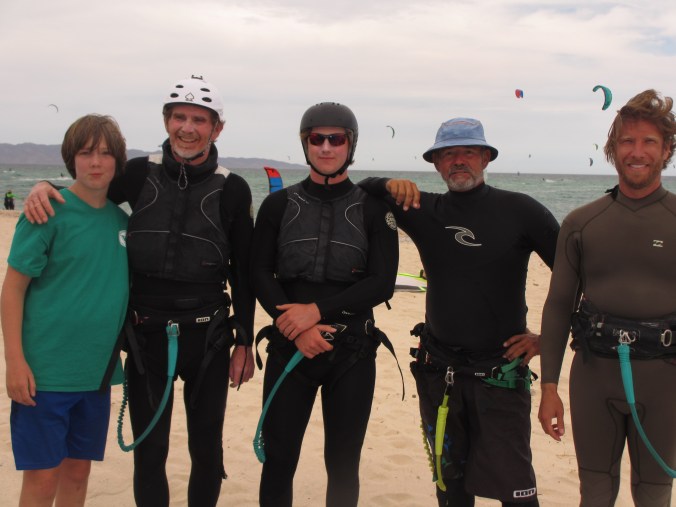
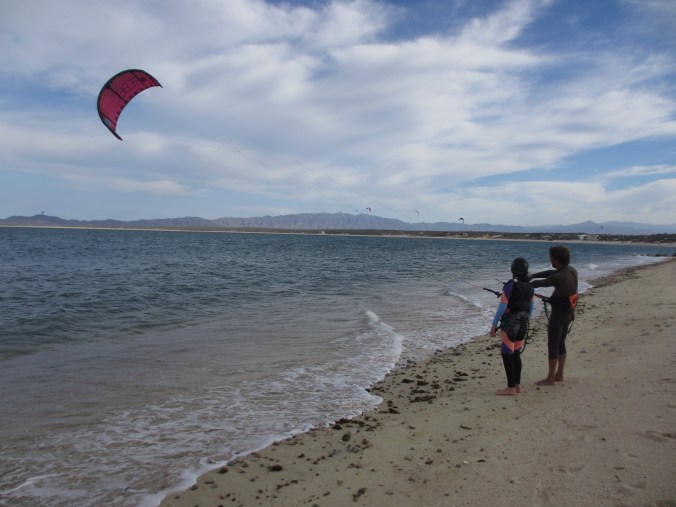
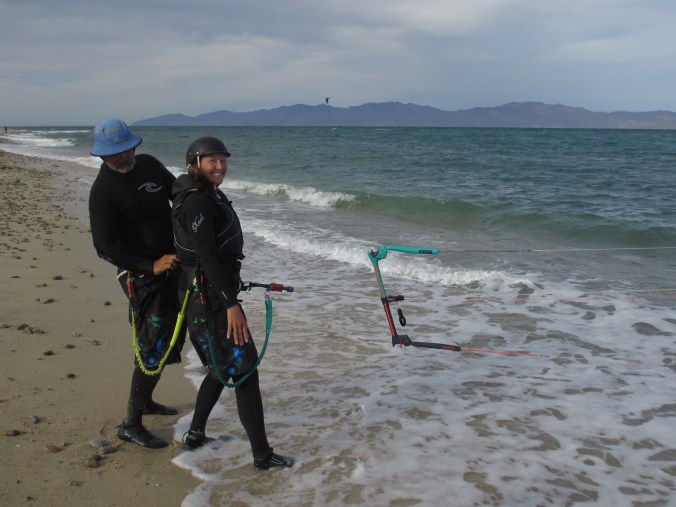
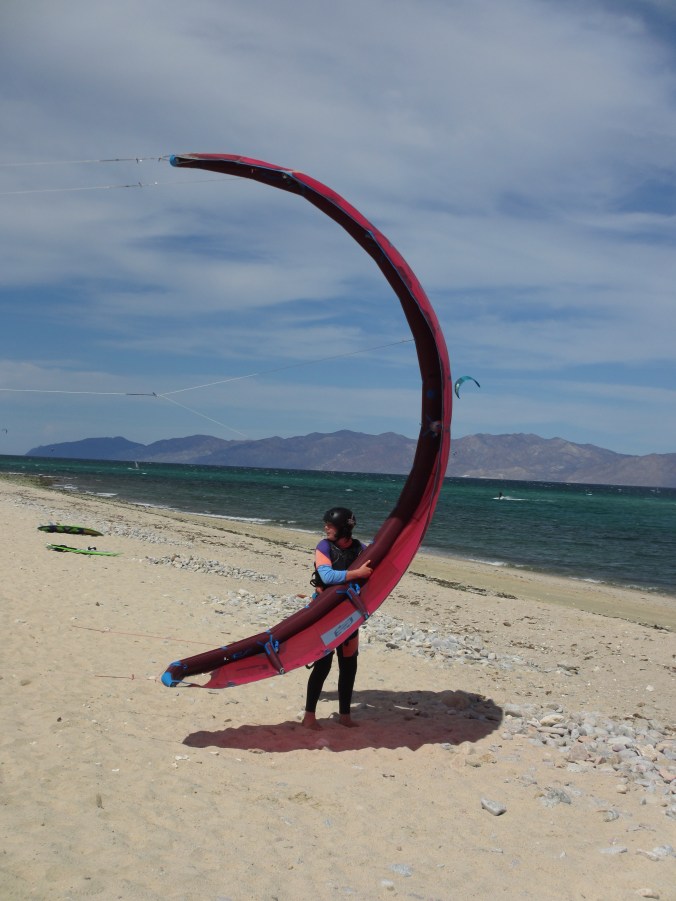
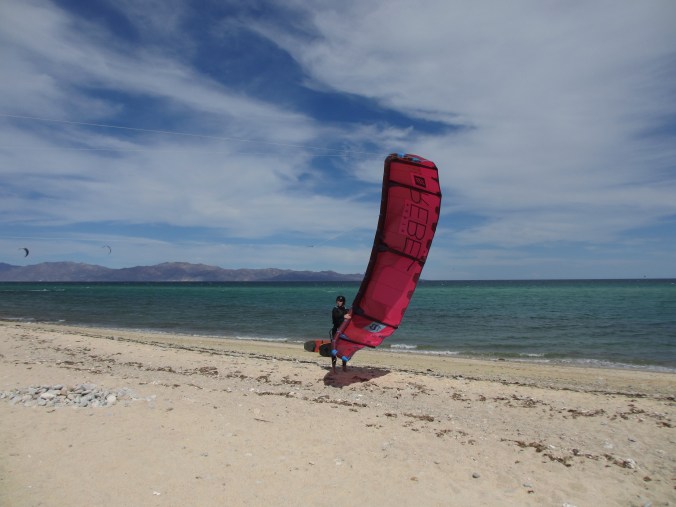
Day One: With the wind line forming, Norm (co-proprieter of Baja Kite and Surf) gave the thumbs up for lessons. We rented a car for the hour drive to La Ventana, one of the kiteboarding centers of the world, and set off on a new adventure. We had two lessons that day: one on the beach, learning the theory of kiteboarding and playing with a scaled down trainer kite to get the feel for controlling the lines, and the other with a full size kite attached to the harness in the water. Anson and Devon were naturals with the kites, as they had been flying stunt kites for years. Mark and I, although mostly consigned to assist with untangling lines and launches, had occasionally flown the kites, so we weren’t hopeless. We all progressed quickly through those lessons and geared up for an afternoon of body dragging.
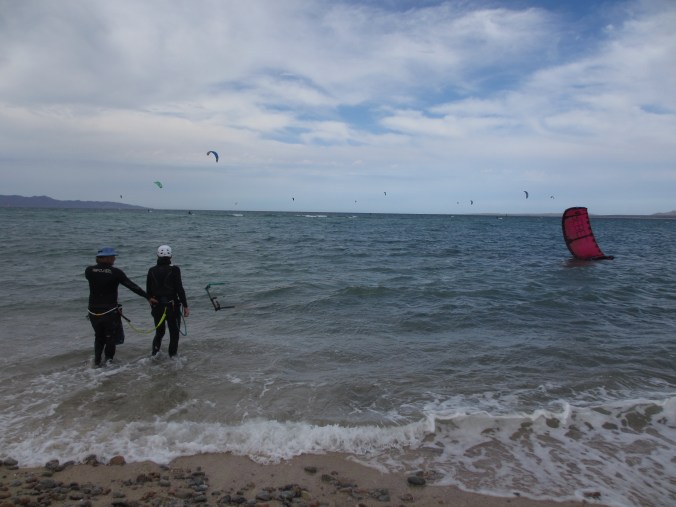
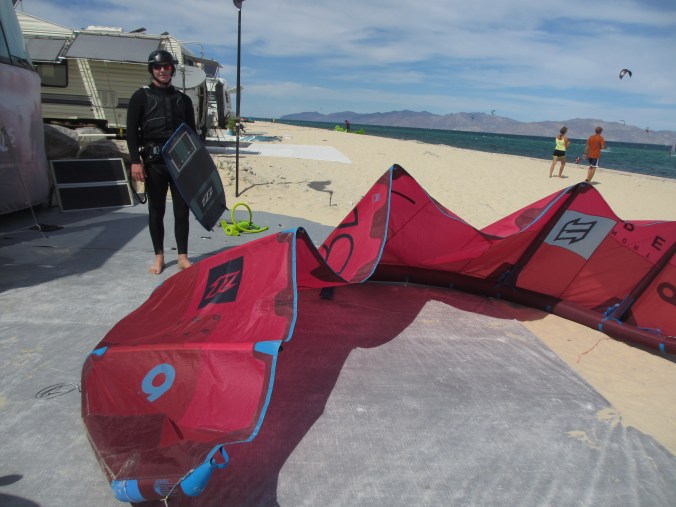
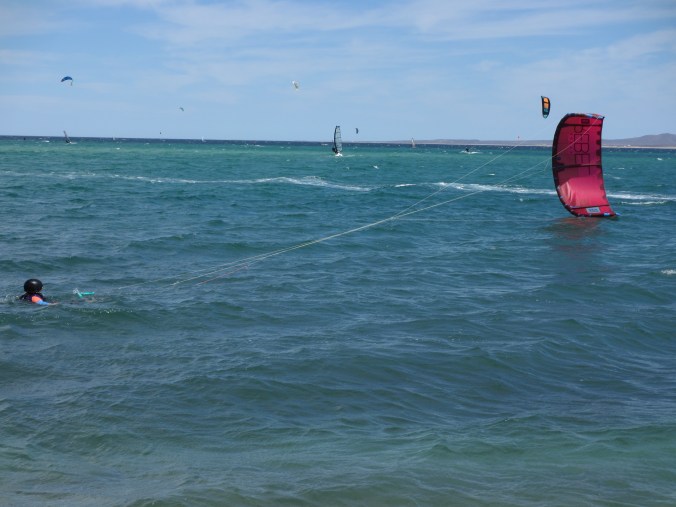
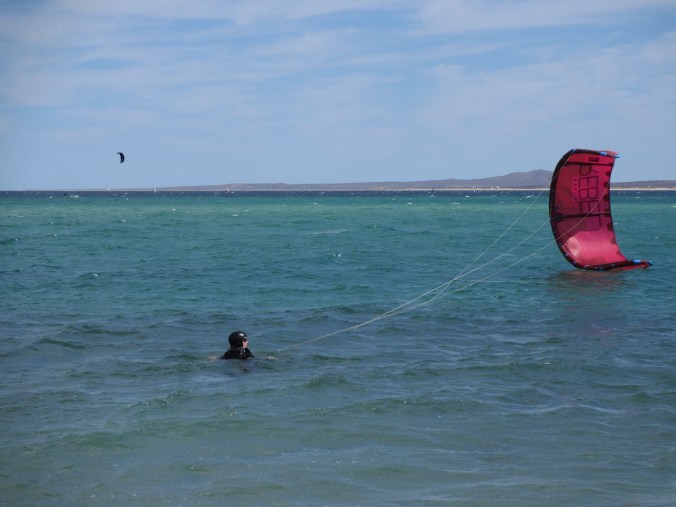
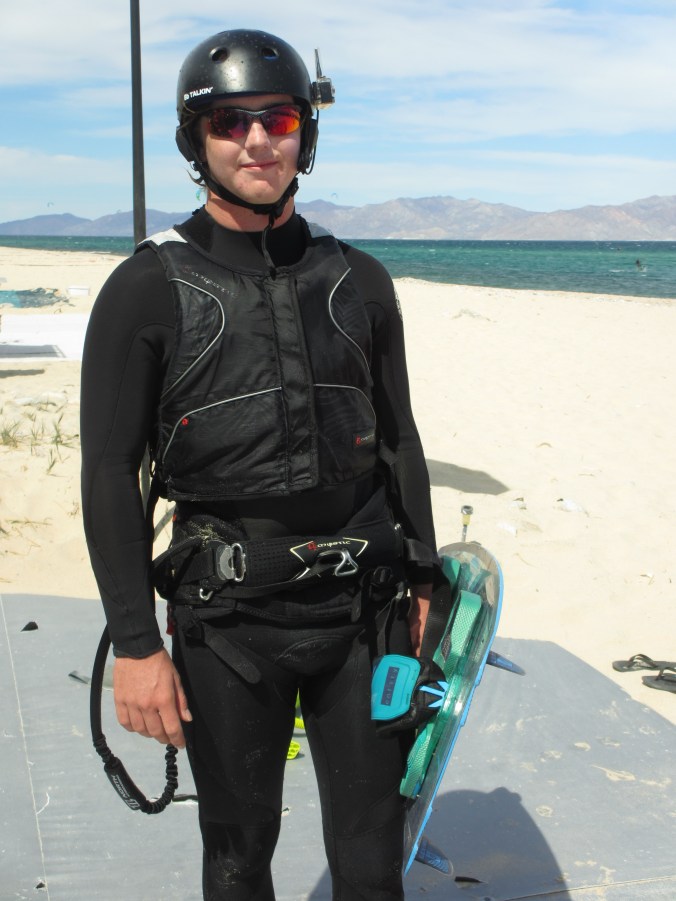
It sounds lethal, but it’s a carefully scaffolded program of skill development. Mark and Anson were the first victims, while Devon and I watched nervously from the safety of the beach. They suited up in wetsuits, helmets and harnesses, swam out to a safe distance from the beach while the instructor flew the kite beside them, and then geared up for the transfer of the kite from instructor harness to victim harness. At this point the kite was resting gently on the water, wing tip up and ready for launch. The lines were barely taught and everything looked quite controlled. Norm ordered Mark to fly the kite, teaching him how to tease it out of the water and asking him to fly it above his head. Up went the kite, arcing across the sky, and down it went in a furious crash onto the ocean. The power of a nine square meter kite is ferocious! At this stage the instructor’s primary responsibility is to hold the student by the harness to keep them from flying up with the kite and into the sky (really). Equally important is their coaching to help build muscle memory for depowering the kite, as most of us respond to increased power by wrestling with the beast rather than simply letting the control bar forward or dropping it altogether.
Once this basic fact is imprinted in muscle, instructors coach the finer points of harnessing the power to move forward. For a body drag this means flying the kite in a powerful figure eight stroke to one side, lurching up out of the water and dragging self and instructor across the bay. Over and over and over, first on the right side, then on the left, until you land half a mile down the crescent shaped beach. Along the way you learn how to use your kite to drag you upwind in case you lose your board, and you demonstrate that you have adequate muscle memory to be trusted for a solo body drag.
While Mark valiantly crashed and relaunched the kite, then lurched forward, dragging Norm behind him, Anson looked like a dolphin gracefully leaping out of the water waist high and keeping his kite moving in a steady figure eight. As his instructor noted, he “killed” it.
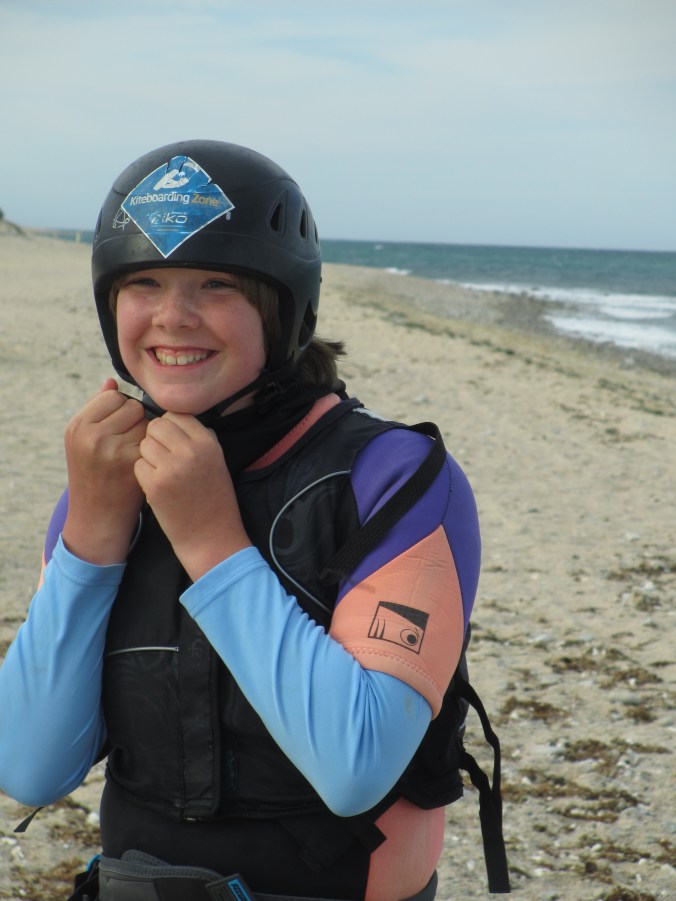
Devon and I then suited up and took our turn. By this time the wind started to lighten, so it will never be known whether I would have “killed it” as well, for I never got beyond the terrifying stage of kite up, high arc and terrifying crash, with Norm saying, “Let it go, let it go. REALLY let it go!” My response to the power of the kite was to hold on tight and try to drive the bar like a car on the edge of plunging into an abyss. After a number of crashes, I shook out my arms and got ready for a light touch, and the wind promptly dropped below 12 knots. At that point Norm took the kite back and body dragged us both to the beach, I feeling a bit like a lumbering dolphin riding a bow wave. Meanwhile Devon proved himself a rock star of kiteboarding. He not only mastered the power stroke and lunge, but managed to find the sweet spot in the dying wind, steering the kite deep into the power zone and then lifting out to provide the surge to travel down the beach. Impressive.
(For those of you wondering whether this sport is suicidal, fear not. The last decade of kiteboarding has focused on developing technology for safety, and the international kite board association has developed a training program (which Norm’s business follows) for building skill sets in a safe progression. My favorite aspect of the gear is the safety release system. First, drop the bar and your kite falls out of the sky; if your kite somehow manages to catch wind and starts dragging you, grab your emergency release line at your waist and a quick pull collapses the kite; if something catches your lines and starts to drag you, a quick pull at your hip and you are completely released from the kite.)
Day Two: The wind came up late, but filled in for a noon lesson. The energy on board went from despondent in the morning to exultant as we hastily threw gear into the car and set off. Anson and Devon had been cleared for solo body drags, and after that the board. Mark and I (especially) needed a repeat of the duo drag. We let the boys go first, as the wind was uncertain and these lessons were combined birthday and Christmas presents to them. They rocked the solo body drags and set off for the exciting moment when they were to put it all together: board on feet, kite in air, to fly like the wind.
I had a profound realization as I saw these rock star students get out on the water and flounder: there were about ten skill sets that had to be mastered simultaneously in order to get up on the board. Just getting the feet in the straps on the board while floating in the water was intimidating, not to mention the swivel of the hips, the angle of the board, the fine tune of balance all while maintaining just the right power stroke of the kite – not too much to land you flat on your face, not too little so that you sink back down – and keep it all going in perfect harmony. Mark, having windsurfed and being a surfer, wasn’t intimidated by the board skills, and so he couldn’t fathom my reluctance to continue. As we watched on the beach and cheered as the boys stood up on the board for one second, then three, then seven and an astonishing twelve, each time ending with a sink or a crash of kite and body, I knew that my decision was reasonable.
Mark persevered with a repeat of the double body drag while the boys took turns on the water and on the beach, each time keeping the kite going for longer and staying upright for more seconds at a time. By the end of the day Mark had completed a solo body drag and was cleared for the board, and the boys were on the cusp of putting all the skills together into their kiteboarding dreams. The instructors were thrilled: teaching rock stars is downright fun.
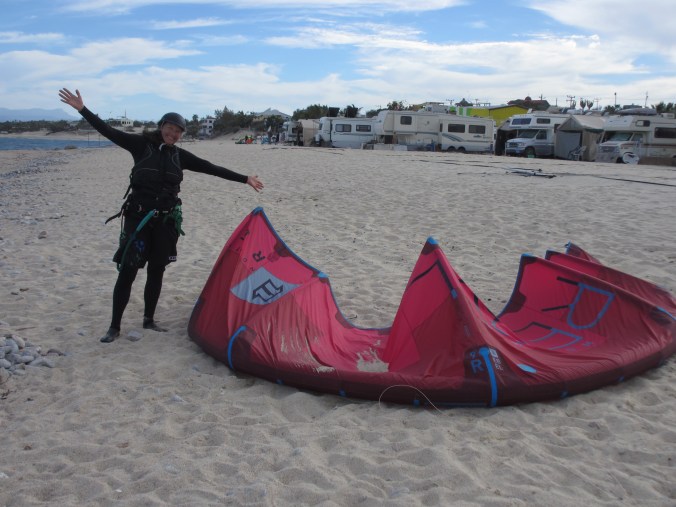
Day Three: Another blessed day of the wind line filling in and a call from Norm to drive down. I stayed on board and read a novel (a nice consolation prize) while the guys geared up for another day of lessons. They came back exultant – Anson “killed” it and was an independent kiteboarder, able to self-rescue, launch and re-launch, and stay up on the board as long as conditions were reasonable. Devon was close behind, with instructors confident that only time on the water was needed before he too would be independent. Mark was a step behind Devon, but clearly able to put it all together with a bit more practice. They were exuberant and exhausted.
Day Four: A day of errands. Every morning the sailors at Marina de la Paz organize a “net” for checking in on the VHF radio. People ask for information and assistance and find out who is arriving and departing. I used the opportunity to see if anyone had paper charts of the South Pacific and received a reply from a generous sailor named “Cappie” who offered up tubes of charts for us to photocopy. (We have two copies of up to date electronic charts, but paper provides us with a physical record of our progress and a needed back up in case all electronics fail. Each chart costs $35 new, thus our plan to borrow and copy.) He’s from Eureka and we quickly discovered a number of people we know in common. Small world. I stayed aboard and sorted through the tubes of charts to identify the 35 we needed, while Mark, Devon and Anson went back to La Ventana to buy kite boarding equipment. A late evening photocopying session and exhaustion all around led us to stay another day in La Paz.
Day Five: Tourists in La Paz. Finally we had a chance to see this beautiful town. Mark and I enjoyed a dawn stroll along the historic Malecon, a tiled walkway along the waterfront, with sculptures and benches dotting the curving expanse. We provisioned and lunched at the Mercado Bravo, a collection of small food stalls in the center of town. The chille rellenos were divine, and it was wonderful to be among families doing their weekly shopping and enjoying delicious food. A tour of the Regional Museum of Anthropology and History provided a tactile and visual supplement to the history of Mexico we have been studying; thank goodness for the cognates in English and Spanish and the generous staff who pointed and explained in Spanish while we responded with Spanglish. The Whale Museum, the recently realized dream of one inspired citizen of La Paz, was beautifully designed, filled with fantastic interpretation, and staffed by guides. We were fortunate to be guided by Jack, a fellow sailor and retired Environmental Science faculty member, who gave us the full tour. We now know to be afraid of crashing into baleen whales, who lack the melon organ for sonar, while feeling safe around the other four types of cetacions! Jack was enthusiastic, as we were interested in all he had to teach. He ended our tour by encouraging us to swim with the whale sharks. Stay tuned. That story coming soon.
 Sail on!