On the 1st of February, while an ex-tropical cyclone blasted past Christchurch, the six of us (Anthea’s crew plus Louise/Nana and Peter/Papa) stowed our luggage and slid our bodies into our Kea Carnival. Almost every question was asked twice and answered thrice, as each of us jumped into the thick of a new dynamic in one of New Zealand’s capacious “people mover” minivans. Laughing at our chaos and redundancy, we quickly realized that “carnival” was the perfect nickname for our month-long “land cruise.”
We journeyed to Aoraki/Mt. Cook, to the Coromandel Peninsula, through Dunedin and along the desolate Catlins Coast, across to Stewart Island, up through the Fjordlands, on towards the Tasman coast and the Franz Joseph glacier, up to Punakaiki and the Pancake Rocks, across to Arthur’s Pass, and back to Queenstown. The photographers (Papa, Anson and Devon) took tens of thousands of photos, all of us learned about flora, fauna, geology and political ecology. Now four weeks later, on our final day together, we have crafted a joint blog, each giving voice to one aspect of our journey.
Louise/Nana:
Best was time with our family. Most surprising was Devon’s height and voice change. Our entire plan worked beautifully: rent a minivan, tour only the South Island, with “Den Mother” Anson scheduling our B and Bs for three or four nights each. We had lots of fun arriving at our new home, checking out beds, kitchen and living space, followed by a mad dash to nest: unpack the car, stow the refrigerator items, find cupboards for the dry goods, then cook supper. Often Devon and Anson regaled us with their baking skills. They made pumpkin rolls with cream cheese filling and chocolate chip cookies several times, as well as cinnamon rolls and carrot cake. Evenings were spent storytelling about sailing, or playing badminton, baking, watching photos taken by Anson, Papa and Devon, or watching a movie, depending on TV and internet availability, and planning the next day’s outings. Moving morning was reverse nesting, with Kim and me making grocery shopping lists and menu planning while packing the kitchen. Occasionally “Papa and Nana” stayed home for a day’s outing, giving needed slow-down time for our 78-year-old bodies. Tomorrow we fly home, much too soon! It’s hard to say goodbye.
Mark:
The most wonderful part of the last month has been the gift of time together – the four of us with grandparents Peter and Louise. The shared memories of all our experiences – from amazing day hikes to recounting of personal and family stories at mealtimes – with enrich the rest of our lives and are a trove that we will enjoy dipping into in the years to come.
I also really appreciated the high drama of New Zealand’s South Island. Severe weather events, originating either from strong gales in the southern ocean or cyclones in the tropics, slam against the island on a regular basis. High winds (often over 100km/hr), heavy precipitation (measured in meters at Milford Sound), snowfall (measured in meters at Arthur’s Pass, and heavy even in the summer) caused flooding, land slips, road closures etc. multiple times during our trip. These weather events, when combined with recent and on-going tectonic activity and violent, mountain-building uplift from colliding plates, produce dramatic landscapes indeed. The glaciers we hiked close to several times were awe-inspiring, as were the landscape-scale moraines, hanging valleys etc. that prior ones had created. Massive on-going erosion and deposition – large, recent alluvial plains, streams clouded with glacial flour, valley floors clogged with washed down debris – created a feeling of a “raw” and actively forming landscape. My appetite is whetted for return trips to further explore these dramatic places.
Anson
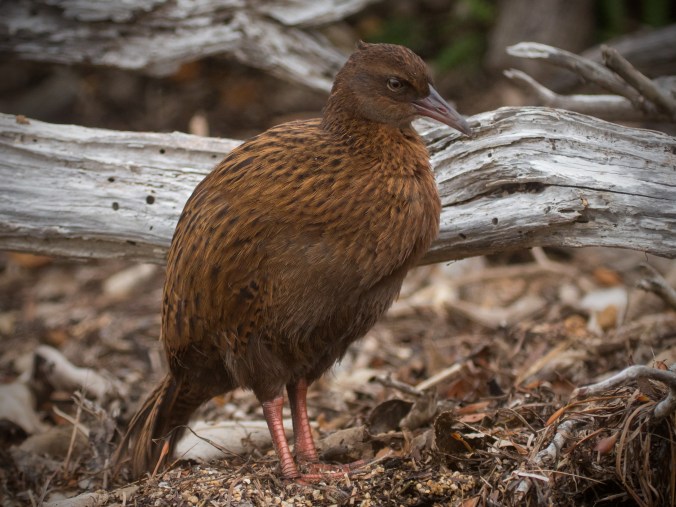
Ulva Island, the idyllic birding location in New Zealand, is so teaming with birds you hardly need to move around the small island to see them all! This is how Ulva island is characterized in the ornithological world of New Zealand. To our great shock and dismay, when we first arrived on Ulva Island to see all of our fine feathered friends, this hype seemed to be unfortunately that, just hype. Upon alighting on the island we were greeted by an eerie silence rather than the anticipated symphony of bird calls. While birds were seen, some of them more often than ideal, the eight hours of birding procured paltry few poultry. There were the requisite Wekas, a flightless bird shamelessly adept at stealing sandwiches from our fingers with an odd running jump. The Stewart Island Robin was a constant beggar during the numerous breaks that a group of six requires. Despite the presence of these endemic birds, the forest felt unnaturally empty.
At almost forty-seven degrees south, the heart of the roaring forties, Ulva Island is subjected to continually morphing harsh weather, an odd place for one of New Zealand’s most lauded bird sanctuaries. After many hard years of predator eradication by the Department of Conservation, this island is now free of the introduced pests such as rats and possums that plague the rest of New Zealand. Ulva Island is one of the few places where the most threatened bird species endemic to New Zealand, the flightless birds and those who nest at or near ground level, can safely nest and raise chicks. The island is portrayed as a liferaft for the preservation of endangered bird species by the Department of Conservation due to its pest free state.
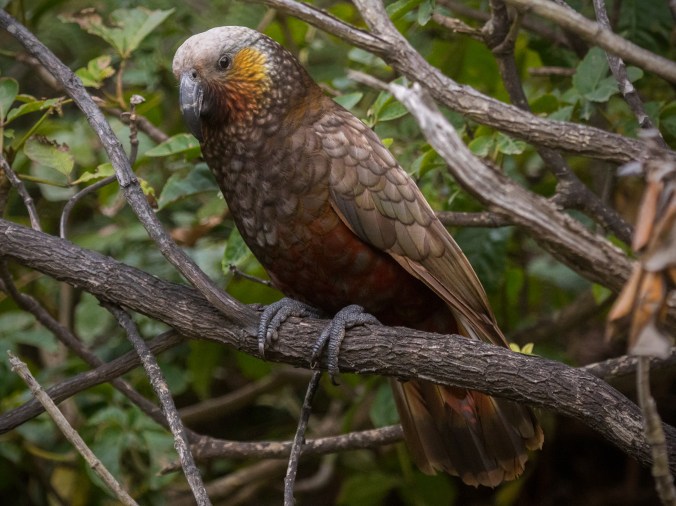
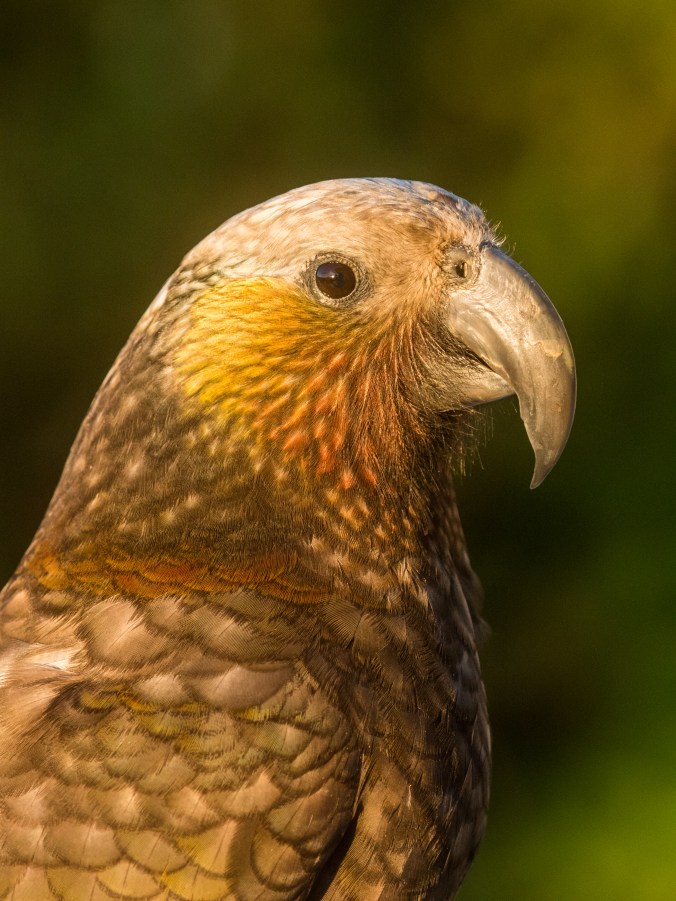
There is no town to stay in on Ulva Island. Instead, visitors stay on the much larger Stewart Island, which partially surrounds Ulva Island. We had four glorious nights on Stewart Island, with our first trip to Ulva Island taking place on the day after arriving. On our second day, we enjoyed the presence of the same Kaka, a large parrot, that we had spent a quarter of an hour photographing the night we arrived. Kim, Mark and I went on a day hike on our third day in an attempt to spot the Kiwi, a flightless nocturnal bird, infamous for being difficult to find. Much to our delight, at a sunny half-past-three, we stumbled along this odd creature as it slowly crossed the walking track. The kiwi did not seem to notice our blundering presence as we observed it swish its bill through the loam, searching for food. Returning to our beautiful house overlooking the harbor, I decided that the next morning I would return to Ulva Island for one more try before our afternoon ferry back to the mainland.
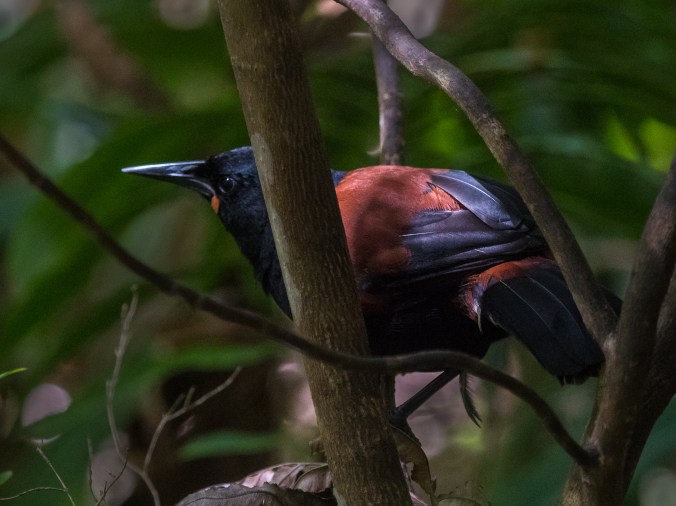
I woke up early to catch the morning ferry. Just as I was about to walk out the door for the short walk to the dock, Mark suddenly decided that he was joining despite the fact that twenty minutes ago he was asleep! There began the mad rush to prepare him for the day including adding the necessary snacks and water. With only minutes to spare, we walked out the door, making our way over the hill to the ferry dock. Thankfully the fog was disappearing, with the skies clearing completely on our short ride to Ulva Island. The contrast between our first and second birding expeditions to the island could not have been more stark. This time we were greeted by a chorus of bird songs, complemented by the beat of wings and the crackle of bills cracking seeds. We were suddenly sighting all the birds that Ulva Island is known for. We first happened across the Saddleback, a stunning black and orange bird, and one of the success stories of Ulva Island. Its population had dropped to a frightening thirty-six in 1964 and is now estimated to be over two-thousand. This darshan (sacred viewing) was followed by an almost continuous stream of Kakas and Red-Crowned Parakeets. Only minutes before departing I came across the Yellow-Crowned Parakeet, the final bird we had hoped to see.
Devon: Milford Sound
As one of the biggest tourist attraction in New Zealand, thousands of people come to Milford Sound, filtering through the crowded parking lot. We (Peter, Louise, Mark, Kim, Anson, and I), spent ten minutes waiting for a car to leave before we could park. A five-minute walk ensued which ended at the bustling tour boat terminal. We had our lunch before boarding our relatively small (80 feet and 2 story, instead of 200 feet and 3 story) boat. We left the dock at 2:30 to start our tour of Milford Sound.
Milford Sound is a fjord, a body of salt water that connects to the ocean. It was created by a series of glaciers during the last ice age. We traveled along the edge, going by thousands of diverse waterfalls: some hundreds of feet tall and roaring past, others a small trickle creeping down the steep rock faces. Landslides were common, patches of earth shining through, the evidence of a tree falling and the interconnecting roots taking many more with it. A commentator talked throughout it all, telling us about the geology, the flora and fauna we were seeing, and Milford Sound’s culture significance to Maori. We went under several waterfalls, letting crazy people, like Mark and Kim, get drenched. Two hours and 45 minutes later we arrived back at the dock to disembark and drive home.
Kim – Te Anau to Kinloch to Franz Joseph Glacier
Our carnival journeyed from the high drama of Milford Sound’s endless waterfalls, through the chaos of Queenstown, and up the lightning bolt-shaped Lake Wakatipu. We were buffeted by 20-30 knot winds as we drove along the winding lakeside drive towards our next BnB in Kinloch. Wind waves drenched the beaches in foam and the sun shone through the sand storm at the head of the lake, casting a glow around Pigeon Island. Our cozy farm cottage was on the gravel road to the Routeburn track, one of the great walks of New Zealand. Vans and buses ferried hikers, none of whom seemed at all disturbed by the forecast of another ex-tropical cyclone bearing down on the South Island.
Nana and Papa opted to stay home while Mark, Anson, Devon and I set out in the cold and rain to climb the Rockburn track (which branches off the Routeburn) to Sugarloaf Saddle, a steep ascent to get us above the tree line for views. For Devon it was an unwanted hike from hell, but the rest of us kept up our spirits as we ascended the path that was more roots and rocks than earth. It was a miserable day for a hike: cold, wet and so rainy that the mountain spouted waterfalls and our trail became a stream. But the magic of the forest still surrounded us, and the beauty of the tussock ecosystem, with its dense mosses, late summer alpine flowers and bunches of native grass, made the effort of the hike worthwhile. From the saddle we got views of near peaks, with splotches of snow, and glimpses of distant mountains between fast scudding clouds. The cold wind drove us from the saddle and soon we were back in the beech forest and descending quickly towards our cozy home. We arrived to find that Nana and Papa had the best views of the day by simply walking among the cows and chickens in the pasture behind the house! A lovely vista of distant peaks was framed by the river valley abutting the property. Go figure!
The next day we woke to snow which had been carried to the peaks by the winds and moisture on the bottom edge of the extra-tropical cyclone. Our drive out of Kinlock and to the Franz Joseph glacier was interspersed with numerous photography stops and a few gentle walks. With their elegant mantle of white contrasting with a sunny blue sky, the snow-capped mountains lent a sense of grandeur to the landscape. As with so much of this trip we felt blessed: blessed to have the health and means to enjoy a month “land cruising” together, blessed to share old stories and create new ones, and blessed simply to be in each other’s presence.
Peter/Papa A Surfeit of Celebrations
One of the more unappreciated facts of having been born and married in the western hemisphere is that when one travels with one’s mate to the Eastern hemisphere, e.g., New Zealand (which is right at the border of the international date line), it is considered proper to celebrate one’s important life events on two different days. First the Eastern Hemisphere celebration, followed the next day by the celebration of the proper day in the Western hemisphere. On February 24th, for our 56th wedding anniversary, we were royally feted with brunch in bed and later in the evening wine, hors d’oeuvres and a delicious chicken curry, followed by Anson’s amazing chocolate chip cookies.
The day of my 78th NZ birthday, February 25th, we drove from Franz Joseph Glacier to Punakaiki on the windswept northwest coast to a magnificently sighted cabin far above the breaking storm waves which roared in our ears. Mark had procured a large cut of salmon which he grilled to perfection. Devon asked me what sort of cake I would prefer, and I replied that his carrot cake was the best I had ever eaten, and he promised to surpass it. However, there was one challenge that at first seemed insurmountable: the house had no oven, only a two burner propane cook top and an outdoor grill of questionable operability. After an afternoon of intensive ingredient preparation, Anson and Devon attacked the ancient Weber grill and found that there was a way that might possibly work if they could only elevate the cake above the grill plate and control the temperature. Thank the gods of the grills for working thermostats! It was preheated, and after juggling the controls, the cake was popped in; half an hour later emerged the miraculous creation that only needed two pounds of cream cheese frosting to complete the cake.
Let the party begin! Decked out in party hats we each had handfuls of poppers shooting confetti all over the place. Suddenly it was a battle zone. Then came the cake. What a creation! The old man saw that there were considerably fewer than 78 candles on it, so he thought this would be a piece of cake. But come his huffing and puffing, he could only get a few out, and others would miraculously come to light with sparkles and renewed vigor. The only way we could dowse the candles was to throw them flame down into a glass of water. Fortunately, there was enough cake to supply a second celebration the following night, my proper birthday in the Western Hemisphere.
 Sail on!